Skip to content

Shankar Dutt · Research Fellow, ANU

Reading biology, one molecule at a time.

I build solid-state nanopore instruments that read single molecules, and teach machines to interpret them. The measurements connect nanoscale physics with questions in biology and diagnostics.

Research School of Physics, Australian National University, Canberra. Curriculum vitae (PDF)

Illustrative schematic · not experimental data · not to scale

Cutaway of a solid-state nanoporeA thin silicon nitride membrane on a silicon support separates an upper (cis) and a lower (trans) reservoir. Ions flow through a single pore at the centre. A molecule moves from the upper reservoir, through the pore, into the lower reservoir.cis reservoirtrans reservoirbiasSi supportnanoporea few nm acrossSiNₓ membranemolecule (schematic)Ionic current against timeThe current sits at a steady open-pore level, drops while the molecule occupies the pore, and returns to the open-pore level after it leaves. The drop is labelled ΔI and its duration Δt.ItopenΔIΔt

The depth of the blockade (ΔI) and its duration (Δt) are the measurement. Their distribution over many events is what distinguishes one kind of molecule from another.

What do ΔI and Δt mean?
ΔI · blockade depth.
How much of the ionic current the molecule blocks; it depends mainly on the molecule's volume relative to the pore.
Δt · dwell time.
How long the molecule stays in the pore; it depends on its charge, shape and interactions with the pore wall.
Fig. 1A molecule passing through a solid-state nanopore and the current blockade it produces. For a published measurement, see protein identification (Small Methods, 2023).Illustrative schematic, not experimental data, not to scale.
Journal articles
22
Peer-reviewed journal articles, counted from the curated publication list on this site.
Publication list · as of Jul 2026
Patent applications
2
Applications filed in 2021 on methods of fabricating nanopores (international phase: USA, Europe, China, Japan, Australia) and membranes (PCT phase).
CV (Nov 2025) · as of Nov 2025
Students supervised
24
5 PhD (primary or associate), 3 Honours and 16 undergraduate or masters research students.
CV (Nov 2025) · as of Nov 2025
Cash funding (AUD)
500k+
Competitive cash grants on which I am a named investigator, in any role (lead, co-investigator or collaborating entrepreneur), 2019–2025.
CV (Nov 2025); itemised on the Recognition page · as of Nov 2025

02Selected discoveries

What the measurements have shown

From blockade events to protein classesA current trace with three blockade events of different depth, duration and shape. The second event is annotated with its depth, duration and a two-step shape. Features from each event feed a classifier that assigns a protein class.ΔIΔtshape (two-level)currentone event per molecule, thousands of events per proteinΔIΔtshape…classifierclass A/B/Cfeature vector
Fig. 2The features of a single blockade event used to tell proteins apart: depth, duration and shape.Illustrative redraw of the analysis concept, not experimental data, 2023, doi:10.1002/smtd.202300676.

01Published result

Telling proteins apart by their electrical signatures

Can a nanopore distinguish proteins of similar size without any labels?

Each protein that crosses the pore leaves a brief current blockade. We trained machine-learning models on features of thousands of such events to identify which protein produced each one.

Label-free identification of similarly sized proteins reached F-values up to 88.7%, with specificity of 96.4%.

First author. Small Methods 7(11), 2300676 (2023).
Read the paperApproach and limitations

Two conformations, two current levelsLeft: two schematic conformations of a tRNA, a compact L-shape labelled conformer A and a more extended shape labelled conformer B. Right: a current trace whose blockade events fall into two distinct levels, with a histogram showing two peaks, one per conformer.conformer Aconformer Bsame tRNA sequence, different foldcurrentlevel Alevel Bcounts
Fig. 3Two conformations of a tRNA and the distinct current levels they produce.Illustrative schematic of the concept, not experimental data, 2026, doi:10.1093/nar/gkaf1411.

02Published result

Watching an RNA change shape

Does a disease-linked mutation change how a transfer RNA folds?

Transfer RNAs must fold correctly to work. We used solid-state nanopores to read individual tRNA molecules in real time and follow the conformations that a single mutation produces.

Single-molecule detection of metastable conformers of a neuron-specific tRNA, whose mutation causes neurodegeneration in mice; these states are invisible to ensemble methods.

First author. The first solid-state nanopore study of RNA conformational dynamics. Nucleic Acids Research 54(2), gkaf1411 (2026).

Read the paperApproach and limitations

03Published result

Membranes that last for millions of events

Can a solid-state pore stay stable long enough to collect the data machine learning needs?

Classifiers need very large numbers of events from the same pore. We developed a scalable way to make ultra-thin silicon nitride membranes that stay stable for long recordings.

Membranes with an effective thickness of about 3 nm supported more than 500,000 DNA and 1.8 million protein translocations through a single pore.

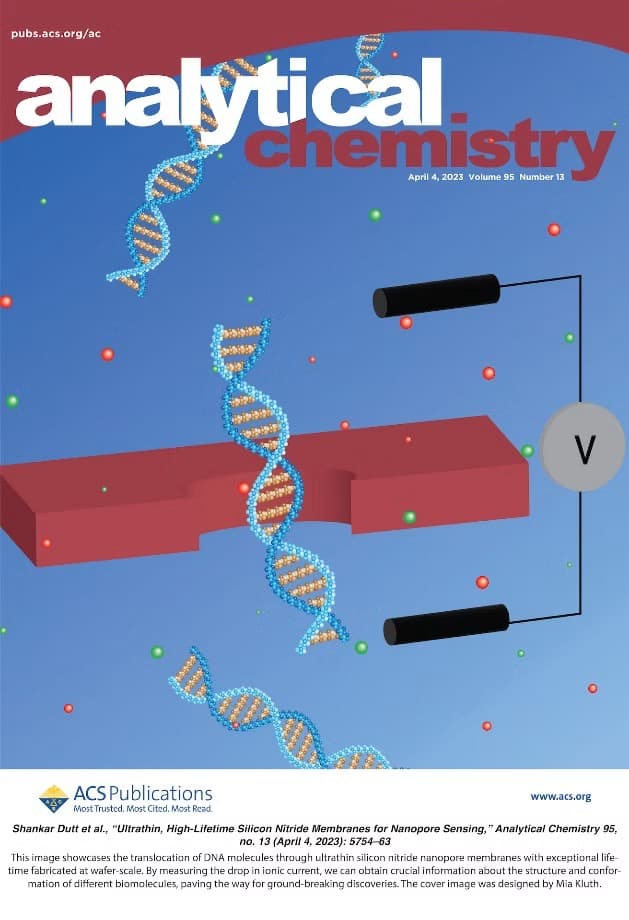
First author; featured on the cover of Analytical Chemistry. Analytical Chemistry 95(13), 5754–5763 (2023).

Read the paperApproach and limitations

Cover of Analytical Chemistry, volume 95, number 13, 4 April 2023: DNA strands passing through a pore in a thin membrane between two electrodes.
Fig. 4Cover of Analytical Chemistry 95(13), 4 April 2023, featuring the ultra-thin silicon nitride membrane study.Journal cover artwork, 2023, doi:10.1021/acs.analchem.3c00023.Cover image designed by Mia Kluth; © American Chemical Society.

03Inside the research

How I work

Portrait of Shankar Dutt
Shankar Dutt, Research School of Physics, ANU.

I trained as a physicist, and I still think like one: build the instrument carefully, then trust what it measures.

My PhD at ANU was on making solid-state nanopore membranes, using ion-track etching, controlled breakdown and thin-film deposition, and measuring pore shapes with small-angle X-ray scattering at the Australian Synchrotron. Since 2023 I have led the lab's work on using those pores as sensors: recording single proteins and RNAs, and writing the software and models that turn millions of current blockades into answers.

I co-manage the biosensing, solid-state nanopore and thin-film laboratories, supervise research students at every level, and run the first-year physics laboratories.

04Selected papers

Also worth reading

Three further papers from a list of twenty-two. The three studies above are cited with their stories.

  1. 2021FabricationIon tracks & SAXS

    Shape of nanopores in track-etched polycarbonate membranes

    S. Dutt, P. Apel, N. Lizunov, C. Notthoff, Q. Wen, C. Trautmann, P. Mota-Santiago, N. Kirby, P. Kluth

    Journal of Membrane Science 638, 119681 (2021)

    First quantitative characterisation of nanopore shape in track-etched polycarbonate membranes, a question that had been open for about 40 years.

  2. 2024Methods & software

    A Robust Parallel Computing Data Extraction Framework for Nanopore Experiments

    Y. M. Bandara, S. Dutt, B. Karawdeniya, J. Saharia, P. Kluth, A. Tricoli

    Small Methods 8(12), 2400045 (2024)

    A parallel, multi-core event-extraction framework for large nanopore datasets, up to 1120× faster than existing tools under the benchmark conditions reported.

  3. 2023Ion transportFabrication

    Highly Rectifying Conical Nanopores in Amorphous SiO2 Membranes for Nanofluidic Osmotic Power Generation and Electroosmotic Pumps

    A. Kiy, S. Dutt, C. Notthoff, M. E. Toimil-Molares, N. Kirby, P. Kluth

    ACS Applied Nano Materials 6(10), 8564–8573 (2023)

    Conical nanopores in amorphous SiO2 with finely tunable surface charge and strong ionic rectification, made by a scalable method.

All publications, searchable, with BibTeX

05Recognition and recent work

Recently

Now updated Sep 2026

  • 2026The tRNA conformation study is out in Nucleic Acids Research.
  • 2025–Leading an Australia's Economic Accelerator Ignite project with Thaum Pty Ltd on nanopore detection of Alzheimer's biomarkers.
  • 2024–Academic in charge of first-year physics laboratories (PHYS1101), about 350 students a year.

Selected distinctions

  • 2025AI Academic/Researcher of the Year, finalistAustralian AI Awards
  • 2025AINSE Early Career Researcher GrantAustralian Institute of Nuclear Science and Engineering
  • 2024Neville Fletcher Early Career Research AwardResearch School of Physics, ANU
  • 2023Elsevier NIMB Young Researcher AwardNuclear Instruments and Methods in Physics Research B
  • 2022Jak Kelly AwardRoyal Society of New South Wales
All awards, grants and talks

In the press

100+ News stories on the 2023 protein-identification study, including ABC and 2GB radio and outlets in the US, UK and China.

ABC Radio2GBANU ReporterANU ScienceANU Physics

“We can directly detect and measure shapes in real time, and see how they change their shape from one form to another, at scale.”

All coverage