The other articles here describe published work. This one is about what comes next: five lines of research that are under way or opening up, most of them offered as student projects that I co-supervise with Patrick Kluth at the ANU Research School of Physics. If one of them catches your interest, the last section explains how to get involved.
Protein aggregation, one molecule at a time
Protein aggregation is closely associated with neurodegenerative diseases, including Alzheimer's and Parkinson's. It is not a simple step from single proteins to large fibrils. Along the way, proteins pass through a range of conformations and small clusters called oligomers, many of them short-lived and hard to observe with bulk techniques that average over the whole sample.
Nanopores are well suited to heterogeneous populations because they measure one molecule at a time. With a pore wider than the species we want to measure, monomers and small oligomers pass through intact, and because they differ in size, shape and charge, they should leave different signatures in the current. The project on protein aggregation asks how a protein population evolves as it aggregates, and whether transient states can be detected and told apart.
Depending on level, a student might fabricate and characterise pores, run time-resolved measurements as aggregation proceeds, optimise experimental conditions, or build computational and machine-learning tools for large single-molecule datasets. Previous biological experience is useful but not required. The project builds directly on our tRNA work, which showed that nanopores can resolve different conformations of the same molecule.
Preparing blood for a nanopore
Nanopores can detect biomarkers with high sensitivity in carefully prepared samples. Blood is a different matter. It contains cells, proteins, salts and much else, across an enormous range of sizes and concentrations, and the molecules we care about are often present at low abundance. Before a nanopore can analyse them reliably, the sample has to be processed in a controlled way.
The project on nanofluidic sample processing is about building compact micro- and nanofluidic platforms that separate or enrich selected components of a sample while staying compatible with electrical nanopore measurements downstream. The work can include designing and fabricating fluidic devices, studying transport through small channels and membranes, size- or charge-based separation, and simulating fluid and ion transport. It sits close to Xiang Lian's PhD project, which I supervise, on nanofluidic devices for biomolecular sensing.
Pores that behave like diodes
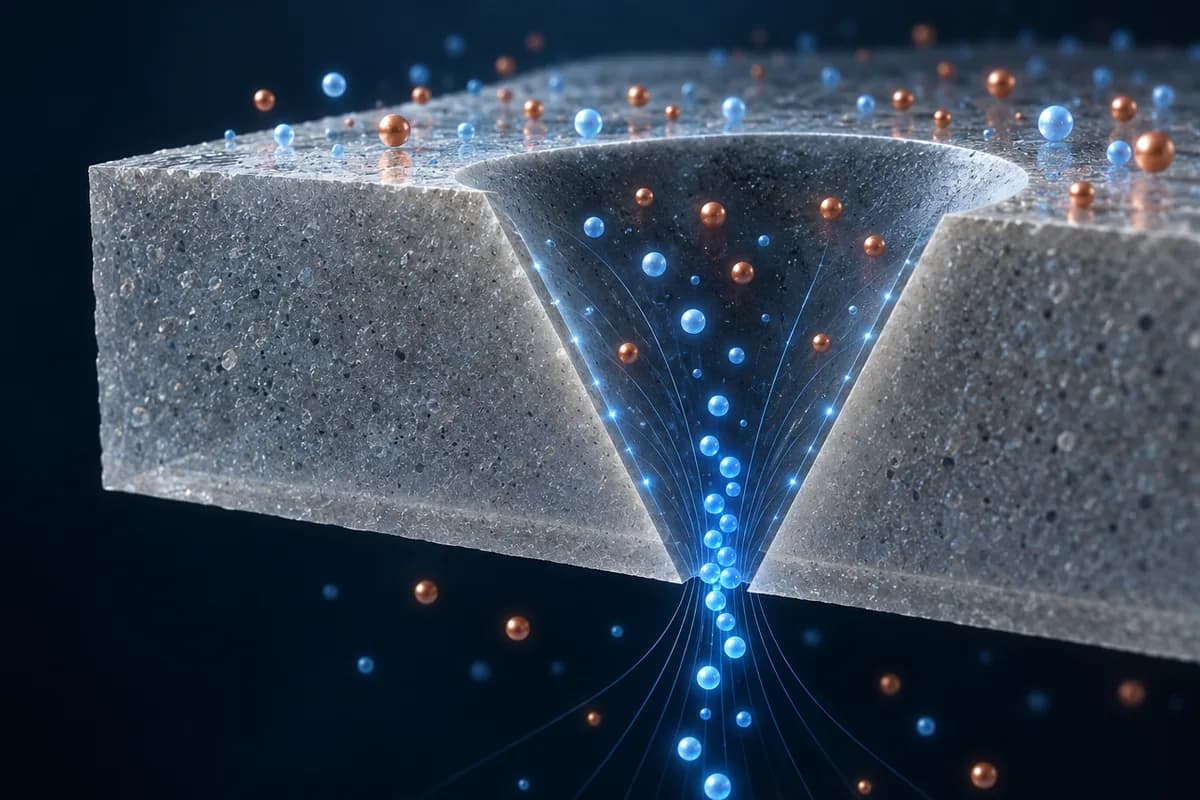
When a pore is only a few nanometres wide, its opening becomes comparable to the Debye length, the distance over which a charged surface influences the ions around it. At that scale, transport through the pore depends critically on the charge of the pore walls. Integrating materials such as HfO₂ and Al₂O₃ into the membrane lets us tune that charge locally, and with it the pore's behaviour: pH-dependent ionic current rectification, gating and ion-specific selectivity all become possible.
The nanofluidic diodes project builds on the platform our group developed for making pores in thin SiO₂ and Si₃N₄ membranes with ion-track technology, with defined shapes and sizes down to a few nanometres. The goal is to demonstrate these pores in biosensing and in ion separation, with water treatment as one application. The fabrication steps are compatible with semiconductor processing, so pores like these could eventually be built into microelectronic components.
This direction already has results. Nahid Afrin, a PhD student I co-supervise, led a study of charge-based molecular separation with conical SiO₂ nanopores (ACS Applied Nano Materials, 2025), and a 2026 preprint reports detection of heart-type fatty acid binding protein at attomolar concentration using ion current rectification in conical SiO₂ nanopores. The preprint has not yet been peer reviewed. My 2025 AINSE Early Career Researcher Grant supports work on highly tunable conical nanopores for biomolecular sensing.
Heavy metals in water
DNAzymes are short DNA sequences that cut a substrate strand when a particular metal ion is present. Sai Vinnakota's PhD project, which I supervise, explores reading that cut with a nanopore. The released fragments are DNA, which threads through a pore, so their appearance could report on the metal ion that triggered the cut.
This is the earliest-stage project on the list. Selectivity, detection limits, sample preparation and performance in real water samples all still need to be tested. The environmental sensing theme on the research page shows the proposed workflow.
Alzheimer's biomarkers in blood
The project that ties most of these threads together is my Australia's Economic Accelerator (AEA) Ignite project with industry partner Thaum Pty Ltd, which I lead. It aims at a solid-state nanopore sensor for rapid, inexpensive and non-invasive early-stage detection of Alzheimer's disease, using protein biomarkers in blood such as neurofilament light chain. It needs sample processing, stable pores and reliable classification, and it builds on our protein-identification work. Lakshmi Raja's PhD project, which I co-supervise, is on blood-based biomarkers of Alzheimer's disease.
The broader nanopore biosensing project collects related topics for students: single-molecule sensing of protein biomarkers for neurodegenerative diseases, machine-learning methods for evaluating nanopore data, controlling how biomolecules translocate through pores, and simulating ion transport through asymmetric pores.
Getting involved
These projects can be tailored for third-year special projects, PhB students, Honours and MSc students, and PhD or MPhil candidates. The nanopore biosensing and nanofluidic diode projects are also open to vacation scholars. You do not need a background in all of physics, biology and data science; the projects suit people interested in working across them, and students work with access to nanopore fabrication and high-bandwidth single-molecule measurement facilities at ANU.
The student opportunities page lists current projects and how to apply. Researchers and industry partners interested in collaborating can get in touch directly.