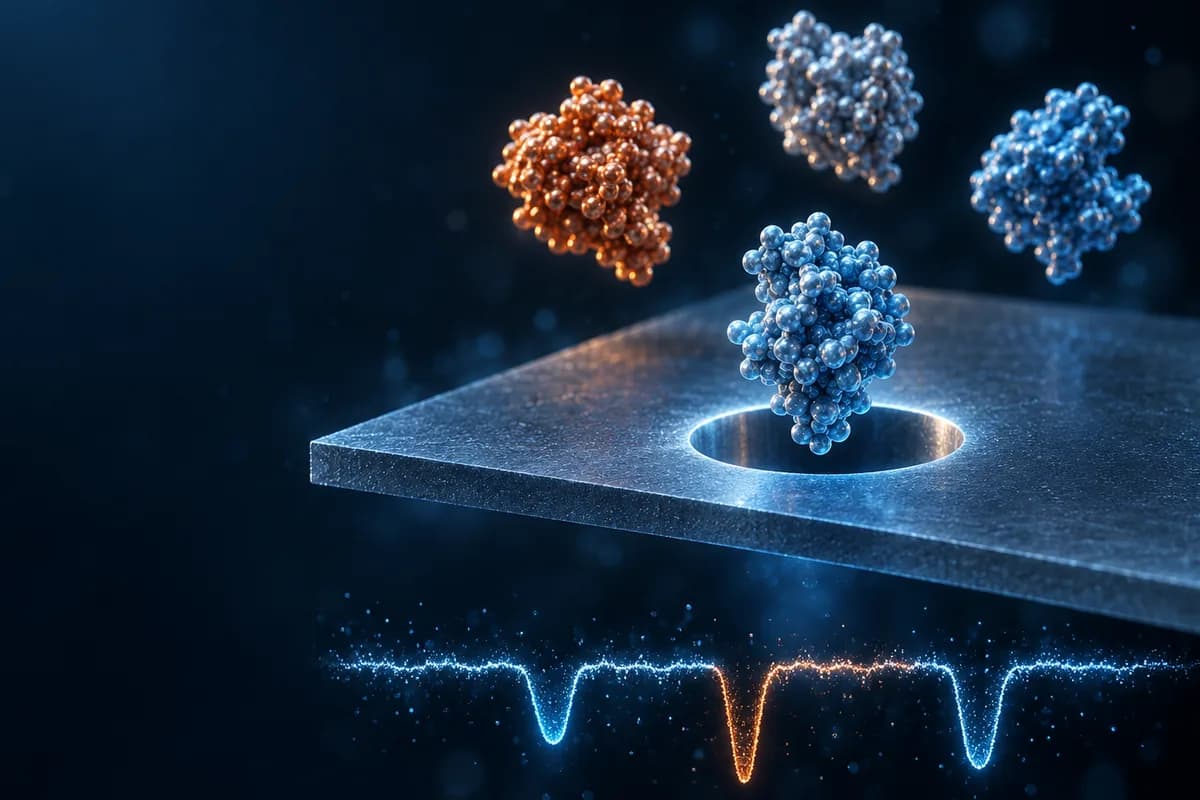
The trouble with size
A nanopore can measure proteins without attaching any labels to them. Each protein passes through the pore intact and leaves a short dip in the ionic current. (If you are new to the measurement, this explainer covers the basics.) When two proteins differ a lot in size, the depths of their dips separate cleanly and telling them apart is easy.
Many of the comparisons that matter are not like that. Proteins of similar size produce overlapping distributions of blockade depth and dwell time, and a threshold on either number misassigns many events. Yet an event holds more than two numbers. The current inside the dip has a profile: how sharply it falls and recovers, how much it fluctuates, whether it sits at one level or more. Our question in the 2023 Small Methods paper was whether machine learning could combine features like these well enough to identify similarly sized proteins from their individual events.
What we found
We built a custom feature-extraction pipeline for high-bandwidth solid-state nanopore recordings and trained machine-learning models on the features it produced. For the proteins in the study, the models reached F-values of up to 88.7% and a specificity of 96.4%, with no labels attached to the proteins.
Both numbers deserve a sentence of explanation. An F-value balances two things: how often the label a model assigns is correct, and how many of a protein's events it labels correctly. A model cannot score well on it by simply ignoring the hard cases. Specificity measures how well the model avoids giving a protein's label to events that belong to something else.
The proteins were purified and measured in buffer. That is the right setting for testing whether the idea works, and it is a long way from a blood sample.
The paper was covered by more than 100 news outlets, mostly because of what this kind of measurement could eventually mean for Alzheimer's testing. ANU Reporter's headline was “Simple test could help predict risk of Alzheimer's disease 20 years in advance”. That headline describes where we want to go; the paper is one step towards it.
The people behind it
Hancheng Shao, who worked on nanopore–AI integration for protein classification as his Engineering Honours project in 2022, is the second author of the paper. He received the ANU University Medal. Machine-learning analysis of nanopore data is still one of the topics open to students in our group.
The paper's other authors are B. I. Karawdeniya, Y. M. N. D. Y. Bandara, E. Daskalaki, H. Suominen and P. Kluth. Our machine-learning work is supported by an NVIDIA GPU grant and Google Cloud research credits, both awarded in 2022.
Getting the data right first
Before any model sees an event, the event has to be found. High-bandwidth recordings are large, and the choices made at this stage, such as filtering and detection thresholds, shape the dataset a model learns from.
In Small Methods (2024), a paper led by Y. M. N. D. Y. Bandara, we described a parallel, multi-core framework for extracting events from nanopore recordings. In the benchmarks reported, it was up to 1120× faster than existing tools. Speed is useful for more than convenience: when extraction is fast, it becomes practical to re-run it with different settings and check how much a result depends on them.
I am now building NanoSense, a Python package that brings event detection, feature extraction and deep-learning classification into one workflow. Its classifiers are one-dimensional convolutional neural networks designed for ionic-current traces. NanoSense is in use within our group, and I plan to release it as open source alongside a paper describing it.
For a broader view of the field, our 2024 review in Future Science OA looks at how nanopore sensing and machine learning are being combined for biomarker analysis and disease detection.
From buffer to blood
The next step is the hard one. I lead an Australia's Economic Accelerator (AEA) Ignite project with industry partner Thaum Pty Ltd, aimed at a solid-state nanopore sensor for rapid, inexpensive and non-invasive early-stage detection of Alzheimer's disease. The work focuses on protein biomarkers in blood, including neurofilament light chain.
Blood contains cells, proteins and salts across an enormous range of sizes and concentrations, and the proteins of interest are rare among them. Two things have to happen before the approach can work there. The sample has to be processed before it reaches the pore, which is the subject of a new student project on nanofluidic sample processing. And a classifier trained in one set of experiments has to keep working on recordings from different pores and different samples. Lakshmi Raja's PhD project, which I co-supervise, is on detecting blood-based biomarkers of Alzheimer's disease with solid-state nanopore sensing.
If you are a student interested in the space between physics and data science, the student opportunities page lists the projects I can supervise.