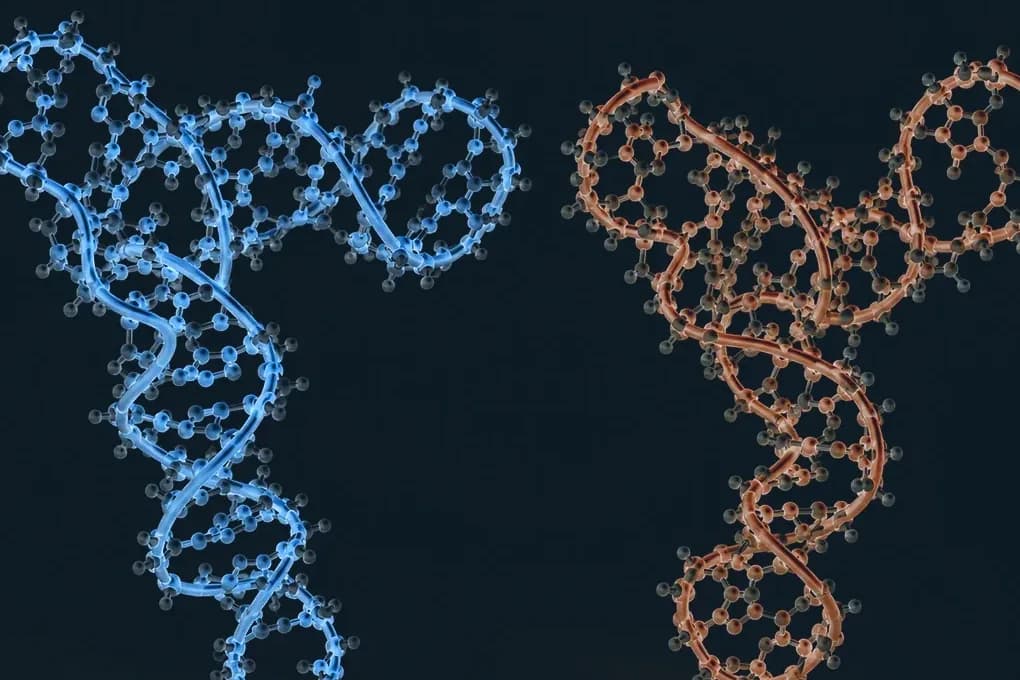
A small RNA with an exact job
Transfer RNAs carry amino acids to the ribosome as proteins are made, and they are the molecules that read the genetic code. Each is a short strand of RNA, under a hundred nucleotides long, that folds into a compact shape. That fold has to be right for the molecule to do its job.
The tRNA in our Nucleic Acids Research paper (2026) is a neuron-specific tRNA that carries the amino acid arginine. A mutation in it causes neurodegeneration in mice. We wanted to know whether the mutation changes the shape of the molecule, and whether a solid-state nanopore could see the difference.
Why measure one molecule at a time
Most structural and biochemical methods measure a large population of molecules at once and report an average. That works well when the molecules are all alike. RNA often is not: the same sequence can fold into more than one shape, some of them metastable, meaning they persist for a while without being the most stable arrangement. A population can therefore be a mixture. If it is split between two shapes, the average describes a shape that no individual molecule actually has.
A nanopore measures each molecule separately. The pore is wider than the folded tRNA, so the molecule passes through intact, and its event reflects the conformation it had as it went through. Different conformations exclude different volumes of electrolyte and interact differently with the pore, so they can appear as different blockade levels and dwell times. Collect enough events and the distribution shows how the population is divided among its states, including minor states that an average would hide. Seeing a minor state reliably takes many events, which is one reason stable, long-lived pores matter for this kind of study. (For the basics of how a blockade arises, see this explainer.)
What we saw
Using solid-state nanopores, we detected metastable conformers of this tRNA at the single-molecule level, and we observed the conformational change that the mutation induces. To our knowledge, it is the first solid-state nanopore study of tRNA conformational dynamics. As I put it to ANU Reporter, “We can directly detect and measure shapes in real time, and see how they change their shape from one form to another, at scale.”
Two points about what this means. First, the method is label-free: the tRNA is measured as it is, without fluorescent tags or other labels that might themselves affect how it folds. Second, it gives a direct handle on the relationship between a disease-causing mutation and molecular shape, which is the kind of structural change thought to underlie several neurodegenerative diseases.
The conformations are inferred from electrical signatures under the conditions of the experiment. A nanopore event is a measurement of how a molecule blocks a pore, not a molecular structure, and the drawings of tRNA on this site are schematics rather than solved structures.
Who made it possible
This paper depended on RNA biochemistry as much as on nanopore physics. The authors are L. B. Lai, R. Mehta, B. I. Karawdeniya, Y. M. N. D. Y. Bandara, A. J. Clulow, S. Glatt, V. Gopalan, P. Kluth and me, and the collaboration links our group at ANU with researchers at The Ohio State University and Jagiellonian University in Kraków.
The work was covered by ANU Reporter, under the headline “Scientists develop technique to identify malfunctions in our genetic code”, and by ANU Physics in “Nanopores reveal glitches in tRNA, unlock a world of biochemical understanding”.
Where it leads
Two directions follow naturally. The first is to ask how small molecules, including potential drugs, change the conformations of an RNA like this one. If a nanopore can see a mutation shift a molecule's shape, it may also be able to see a compound shift it back, which is relevant to RNA-targeted therapeutics. That work has not been done yet.
The second is to apply the same single-molecule logic to proteins that change shape and stick together. Protein aggregation is associated with Alzheimer's and Parkinson's disease, and the intermediate states along the way are short-lived and hard to observe in bulk measurements. That is the subject of a new student project, described in an article on the projects we are opening up.
The RNA theme on the research page has a schematic animation of this work, and the full paper is in Nucleic Acids Research.